Ribs of Fire
—Written for Frida Kahlo
Ribs of fire
In the cleft of night something sprouts
Peaceful kapok trees
Their silk floss floating down
Oozing from the pelvic girdle
A child is being born that cannot cry
Vanilla scented earlobes
Snug against a soft-lipped vulva
You lie upon the tiny open palm
Imagining you hear a beating heart
Dry as bone
You cannot see yourself
In the center of the palm of this hand you light a fire
And in that fire wither
──From Exchanging Lover’s Ribs (2012), published by comma BOOKS
The Normal State of Love: Feeding
After her first blood,
every girl gets a dog.
The day before yesterday, mine arrived—
a fighting dog,
three-legged, crouched at my door.
Before I could gather my thoughts,
it was already lying on my heart,
listening to my most shameful desires.
I try to recall the face of the Bodhisattva,
so I can extend my hand
to touch its missing fourth leg,
and tell it gently:
if you’re hungry, run into the night,
bring down some other girl’s dog,
carry it back in your jaws.
Just don’t trample on anyone else’s lawn.
If you do,
don’t feel guilty.
Come back and hide inside my heart,
you can spit it out slowly, later.
Bite it once.
Then I’ll feed its hunger with my heart.
Before you tear me apart,
you two can keep on fighting,
and together,
raise another dog.
──From Exchanging Lover’s Ribs (2012), published by comma BOOKS
Feeding
Let all my fears
be confirmed.
May I never harvest
never stop
at the end of the hunt.
The deer on my shoulders
still drips blood—
a mark I leave
to find my way
back to the forest.
Darkness waits for me
to turn around.
I step barefoot
into the sweet stream.
Darkness has already set out.
It coils around my calves,
bares the jaws
within its mouth,
slices me open to swell its body,
to store my blood.
I remain still,
wait for it to be full—
then to fall away.
The wound has long since vanished.
Darkness
is nowhere to be found.
I remember—a part of me
remains inside it.
I must return,
return quickly to the forest.
──From I Set Fire in the Field After Sunset (2022), published by Zebra Crossing Press
Where to
I keep mistaking strangers for Jesús.
Any short, dark-skinned man in a denim jacket standing
in the plaza makes me
roll down the window and shout,
“Jesús!”
Jesús doesn’t come.
I walk along the four sides of the Plaza de Armas, longing
to step into a fifth, where Jesús appears,
dimples deep, teeth gleaming,
shyly saying, “I got lost.”
But no, he’s never lost—
Jesús never even set out.
He’s always missing.
They say he skips class, never
takes responsibility for his choices.
Faced with such accusations,
Jesús is silent.
Tears fall.
Is silence
his way of bearing responsibility?
We drive up the mountain,
park at the top,
and step into the wild grass.
We walk the path Jesús
once took to school—
Did he trip over these same uneven slopes?
Did a sudden brook
ever make him pause?
Did he remove his black rubber boots,
bare his black toes, and
let the sweetness of the water
kiss his skin?
When the white mist of cooking fires rose,
did he ever wish
leaving this town?
When the mines roared in the deep of night,
did he tilt his head back, gaze at
the sky full of stars,
longing to burst into light?
How much of the scorching sun
has burned this dark-skinned Jesús?
A dog barks at me.
I stick to the dirt road’s edge,
unwilling to think beyond this moment.
Yesterday, I asked Jesús:
“What’s the question you think about most?”
He tilted his head, dimples appearing.
I said, “What keeps you trapped?”
“It’s serious,” he answered. “I miss my friends.
But I have to leave school. My mother
has no money.
I’m going to Chuguiyo to haul cement.”
Silence returns.
I look at twelve-year-old Jesús. I cannot
tell him: This lesson is called
‘What the Darkness Gives Us.’
By the time we reach Jesús’s home, the darkness
is dense, impenetrable.
At the sight of us,
he covers his eyes,
as if to keep from releasing more of it.
His mother, ignoring the tremble in his shoulders,
tells him to fetch chairs. “No need,” we say.
“We’re just here to take him out for a meal.”
Pigs scream. A guinea pig
scurries past the doorway.
Somewhere, something is pounding.
His mother does not keep silent.
She asks, “Do I need to pay?”
We have no time to feel ashamed of our oversight.
“No, no,” we rush to say. “It’s our treat.”
She nods. Jesús reaches out,
encircling her neck.
Their foreheads press together,
not leaving a gap
for the darkness to seep through.
“Right now, it is so sweet.
If there is anything bitter in him, it is me.
Now, it is so close.
If you see anything from afar in him, that is me.
My mother walks in the orchard,
tasting flavors that have long faded.
If something is broken...”
Jesús borrowed a poetry book from school.
This was his favorite poem. I stayed
silent, not asking why.
Some ancient roads vanish,
descending with a creak.
If something is broken,
we step into knee-deep,
tangled darkness,
more defiant than its thorns.
If something is broken,
Mother, I will think of you,
of your silence kissing the blackened past.
If something is broken, stand behind it
in silence, and before it trembles,
place your hands on its shoulders.
Sunset Prayer
“How long will you stay here?”
“Twenty days.” “Then, I will see you again.”
Feet tread back and forth on the moss-covered rocks,
toes holding a mouthful of seawater before
slowly releasing it. His way of saying “again” feels like
seawater left on his toes, going directly into his shoes.
—As I wrote the dash, a transparent plastic bag caught the wind,
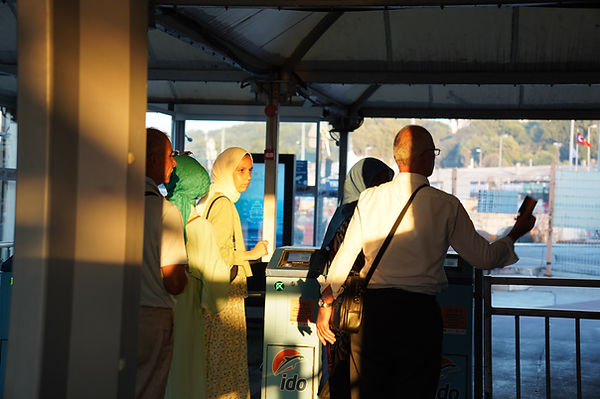
fluttering toward my elbow. The women of Istanbul
spend their days wrapped in headscarves, with sweat tracing the curve
of their cheeks, hanging
at the edge of their jawbones, only to be absorbed by the fabric
before it can fall. To meet again
always takes a bit of luck—no, it simply requires
enough belief. A seagull approaches me,
its sharp beak hooked onto a chain, a rusty pendant hanging from the end,
nearly grazing the ground, becoming a third foot.
That third foot is just—enough belief.
When the wind rushes toward the twists,
—at this very moment, on the coastal road, someone keeps honking
the horn incessantly, as an old-fashioned dark green Mercedes approaches.
The fingers of a bride in white lace hang
at the edge of the rear window. From a distance,
it seems as if she is about to take flight.
The seagull emerges from the bushes,
its beak empty. No one
but me knows it hides a chain. No one
mistakenly thinks the bride is lighter than her veil.
Clearly, she believes it too—believes that hanging
in mid-air is the farthest one can fly.
Do not go near the sea. The sunset strikes
and I sit right where the blade trembles.
You do not, bride, do not entrust so easily
your path to the blood-red road, from afar
it gleams with gold, but that gold vanishes quickly—
too quickly. Do not wait for the wind
rushing toward the twists—it will, as always,
wrap around us, and when we forget to make a wish,
swallow us whole.
To meet again, no one will remember
the chain cast into the sea.
Trivial Matters
I have a duty to tell you—your mother is dead,
the dead-end of our street has come alive, at four in the morning,
the truck by the riverbank starts its engine.
As the northeast monsoon sweeps through,
the sands of the Beinan River sneak through our door cracks and window frames,
covering your photo after death.
Just like your silence, piling thicker and thicker.
Today, I washed the dust from the amethyst geode,
purifying the crystal with the Singing Bowl.
Labor, too, purifies.
Barthes says, here, nothing resonates, nothing crystallizes.
After our mother’s death, scattered dust delicately
lifts our flesh. I have a duty to tell you,
the drama of it all has started to corrode me,
so my steps take flight, preventing you from becoming ignorant:
A Restaurant has closed down. T
he lights at Tiehua Village have gone dark.
Eslite Bookstore is gone. Carp Mountain reveals
its brown intestines. The traffic at the roundabout
remains chaotic. Your favorite diner,
Signature Dish, has moved to Linhai Road,
now renamed Homecoming.
The Taitung theater has turned into a ping-pong hall.
Countless houses pull down their overhead doors,
hammering away within.
In hidden, hollow spaces, they nurture dust.
Barthes says, any desire I had before my mother’s death
cannot be fulfilled now,
lest it mean her death completed it. Now I wait for a new desire
to take form, one born after her death.
I have a duty to tell you—the Asian House rat you set free a decade ago
returned to visit me yesterday. I sat in the garden,
letting the grass you planted drown me. That old rat
came to my feet, showing an expression both ancient and pure,
coming closer and closer—until it realized its mistake.
I was not you. I had disappointed a desire born after your death.
It turned and ran deep into the grass.
Watching the hollow path the rat left in the grass, I broke into ill-timed tears,
realizing that “ill-timed” has become the most restful bed I know.
The memory foam I bought with my first paycheck for you,
unable to forget the shape of your body.
Not a work, Barthes’ old friend said,
but three hundred and thirty scraps of motherless murmurs, published
as an invasion of Barthes' memory.
Not an invasion of Barthes' memory—just that we have no other bed.
In despair, waiting for you, there was still that rat.
While I was busy with the most trivial matters,
it shouldered the ancient and pure duty of refusing
to join our mourning, dustier than dust itself.
Hole
Harrow the clods, shovel them up—
That was Monday, weary labor,
—Breaking things down, relying on
arms raised, arms lowered.
The hole dug out,
as full as a child's eye.
Not so heavy, Tuesday.
More people jumped into the hole,
flattening the walls to prevent
the child’s gaze from rising and falling.
Sometimes, a stone is struck.
One must drop the shovel,
must lower the arms,
let the stone spread the fingers,
let the stone see the light again—
the protrusions
cannot stay inside.
Loyalty to the hollow
is to reject the focal point.
That’s the sentence written in the diary on Wednesday,
a circle drawn around it,
…with a dotted line…
avoiding the gathering of gazes.
On Thursday, I wore rain boots,
waded through the stream, crouched,
and wiped the faces of each stone.
Who is white, and flat
like the future,
firmly placed deep inside the bag.
A scouring sponge, covered with bubbles,
brushed away the sludge in the crevices.
On Friday, when the stones opened their eyes,
they were ready to die.
The fire is coming, run!
This is our last call to you.
Saturday.
All the stones in the hole,
unafraid of the flames,
knowing this is their only chance—
they burn themselves, become whiter,
embracing the promise of the hollow.
Sunday.
All the daughters arrived,
kneeling at the hole’s entrance,
lifting each steaming stone with bare hands,
eating corn, potatoes, bean pods, and lamb
from their mother's body.
They fought with me,
tears harrowed across our dusty faces.
Someone threw a stone and shouted:
“This is my mother, this is
my mother! No one
is emptier than my mother!”
I no longer argued.
Your silence has become mine.
My hollow embraces yours.
.jpg)