Originally published in the September 2026 issue of Wenhsun, as part of its Taipei Poetry Festival feature, this essay documents Yu-Hsuan Wu’s experience leading a life-writing course for MUVE NPO. Beginning from poetry teaching, young people with disabilities, art observation, and lived experience, the essay reflects on how words may return after their existing meanings have dissolved.
_JPG.jpg)
Waiting for Words to Lose Their Meaning
Teaching and Writing|Yu-Hsuan Wu
When we no longer look closely, words die. It is not that words truly die. It is that when we swallow, whole and unexamined, the words others have already chewed for us, words lose their fresh breath. What poetry seeks to reclaim is the act of opening our eyes with nothing in our hands, passing through dust, through skin and flesh, looking a little longer, letting the gaze bore through bone, until at the dark end of seeing, something begins to stir.
Words must first be allowed to lose their meaning. We stay in the place without names, waiting for emotion and experience to hold up a word until it sounds with weight and certainty. Then the second word arrives. One by one, the words return. We must first become unarmed. And so, in the first writing class I led for the staff of MUVE NPO and a group of young people with disabilities, the first exercise was to ask them to pair up, sit face to face, and look directly into each other’s eyes. Do not look away. Do not stop being uneasy.
Some said it was too awkward, so they deliberately made faces. Some said they were so nervous they could not stop laughing. Some began imitating the twitching mouth and expressions of the person across from them. I said, “Everything you are doing is an effort to hide yourselves. What we are practicing is how to live like the two characters of ‘目目’ placed side by side: naked, defenseless, offering ourselves outward while also enduring the eyes that arrive before us. And then, do you dare to face your own experience? Do you dare to look directly at your memory without too quickly beautifying it?”
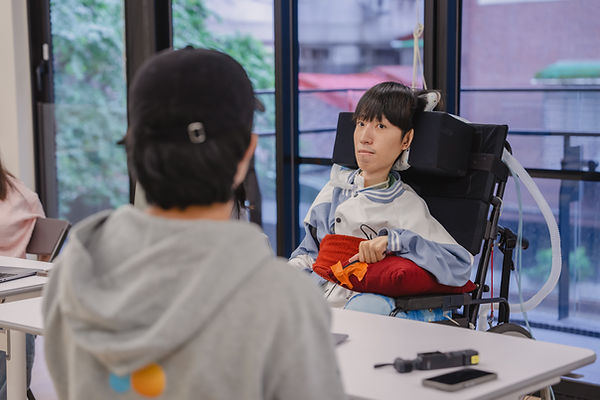
The first step in awakening the poetic mind is always the difficult work of cleansing away dirt. What must be cleansed is not only the layered defenses between looking and being looked at, but also the labels we enshrine in the depths where no one can see. The more labels we unknowingly carry, the more prejudice the words we write must also bear. I asked them: What labels are on your body? Which were given by others? Which did you put on yourself? Which labels have protected you? Which have made you less and less like yourself? Which label do you want to say goodbye to?
One girl said that from the moment she learned to walk and speak, her birth weight of four thousand grams had made her a model for every child in the rehabilitation room. She wanted to say goodbye to being a “model.” One boy said, “In the eyes of the public, I am probably that ‘strong boy’ who sells scratch cards at the night market, always smiling, supporting himself. After repeated surgeries and being scammed, I kept forcing myself to stay calm, to be strong. In the end, I realized that I had even deprived myself of the right to feel sad. I want to say to these labels: ‘I’m sorry, strength and calmness. I don’t need you anymore.’”
Breaking away is not easy, and continuing to bear things also requires courage. Another boy said, “Since I became ill at the age of eight, I have had to keep living with loss. I lost the ability to walk, lost the strength in my hands, slowly lost the strength of my whole body, and even lost the strength to breathe steadily. The freedom to move, and many of the things I wanted to do, have been lost little by little. Illness has trapped my body. To be honest, sometimes I don’t know what the real me is.”
There is a kind of “I” that has no time to be labeled by anyone before fate aggressively cuts away the edges of life, until even the words “myself” become suspect. And it is precisely on the cliff edge of “not knowing what the real me is” that the poetic mind begins to find room to sprout. Not knowing forces you to let go of words whose meanings you already know.
My writing classes always begin by not writing. When words fall too easily, they inevitably follow old patterns of thought, fabricating illusions all along the way. What we have is a restless, wandering mind. So we must first make the mind sharp and attentive, and carefully feel out the ground of who we are. The more tangled and difficult the confusion becomes, the more true words can be squeezed out little by little, tracing the plain yet winding contours of one’s own life with a feeling that lies close to the heart.
What is tangled and difficult is not only our sense of our own existence, but also the miniature universe of an artwork. So I also showed them works by Finnish sculptor Mia Hamari and Russian-born photographer Gueorgui Pinkhassov, one image after another, slowly. I did not explain. I offered no driftwood to cling to. I asked them simply to look, directly and again, abandoning the residue of experience and judgment, looking again and again as if opening their eyes for the first time, unable to resist tracing every detail across the heart. I believe that every work that comes before us will slowly reveal itself and teach us how to read it on its own terms. Do not rush to project familiar things and emotions onto it. Do not refuse when the work speaks to us in a new and blurred language.
In this unarmed act of looking, I asked them to sketch their impressions in a single sentence. No time to polish, no time to be complete. The sentence that leaps out from a sharp perception—catch it. Someone said: the body of a tree keeps growing, in the moment it is moved by the wind. Someone said: the bond between people grows strength inside the chaos of life. Someone said: those who stand firm and unshaken all long to be looked at with loving eyes. The depth of poetry sometimes comes from asking nothing of words, but simply gazing at the wrinkles of life, without any purpose at all.

In a later class, we read “The Unusual Table” by the Turkish poet Edip Cansever together, watching how the poet placed keys, flowers, eggs, the light outside the window, people he liked and disliked, hunger, and infinity all on the same table. I asked them to take ten minutes to list everything they longed to keep on the table of their own lives.
Someone placed “knowing myself” at the center of the table. Someone placed sunflowers and tissue paper in the very middle of a large orange-red round table. Someone said that the table could not be without water, and that there also had to be a piece of bread filled with cranberries and cubes of cheese, along with a towel full of traces of use, absorbing some of what was passing away. Another person said there should be landscapes on the table that no one in the world had ever seen, or the everyday breeze and warm sunlight. Someone else’s table had a small gray cloud, with rain falling from it. On another table, the scenery outside a blurred car window kept shaking; there was sunlight, and shadows were hiding inside it.
None of these tables was empty. My writing class was not meant to have them begin writing poems of life. Instead, I was trying to help them discover that the “I” capable of naming everything is, in fact, written by life.
Life begins writing before we do. An illness, a love, a loss, an ordinary gaze—these have already written the ruptures, repetitions, jump cuts, and inexplicable blank spaces in our lives. Each new encounter rearranges the sentences before and after it, changing the narratives we thought had already been settled.
To wait for words to lose their meaning is to stop speaking on behalf of life. It is to become a receiver, gazing without demand at the traces life has left behind: how life breaks its lines inside the body, how one person’s embrace is carved into one’s own body, how a small encounter quietly alters the place from which one will look at the world thereafter.
If we gaze long enough, something will always reach back and seize us. The tension accumulated within life turns into the necessity of writing. Words rush outward from the places where life has truly been lived—
The words that return are no longer the words they once were.